Posts mit dem Label Taktikanalyse werden angezeigt. Alle Posts anzeigen

Dienstag, 2. Juni 2020

How could additional substitutions affect the title race?

Like their German counterparts, the clubs of the highest Austrian league have decided to take usage of FIFA's step to allow two additional substitutions for the remainder of the season. While it has been argued that this rule change will especially benefit the bigger teams due to their stronger squads, we can use historic data (i.e. the season before lockdown) to deduce which effects the new norm can have, especially on the most important decisions (league winner, European starters and relegation). I also propose a new measurement of squad rotation, which will be affected by the rule change.

A first look at the data shows that most of the teams in the league are quite happy to use the substitutions they are allowed to make (see Graph 1); three of the twelve clubs of Austria's highest league used all of their 66 (22 league games so far). Another seven teams missed very few possibilities to make a change during their games. Only one team (Altach) is more reluctant to make changes within games, rejecting one substitution almost every other game.

Graph 1 (click to enlarge)

There is, however, no relationship between the use of substitutions and teams' position in the table. Among the three clubs at the top of the substitution usage table, there are both highly (LASK) and lowly (Wattens, St. Pölten) classified clubs.

Pure usage figures alone don't tell us a lot about how the rule changes might influence clubs' behaviour, although we can suppose that teams which are very reluctant to even use all three substitutions will also use the additional ones more cautiously.

Likewise, the patterns of substitution timing might be affected. Right now, clubs tend to make their first substitution between minutes 50 and 60 (see Graph 2), although there are some significant differences between them. You would suppose that the first, second and third change will come earlier, so the lines on Graph 2 will be lower on the y-axis. Knowing that they have two more opportunities, coaches might even take advantage of tactical changes in the first half more often.

Graph 2 (click to enlarge)

You can also expect the number of substitutions at half-time to go up, due to the restrictions to three slots in which teams can take off players during the second half. Only seven percent of substitutions so far were done at the break, with newly promoted Wattens the most active team at this time (nine). On the end of the scale, substitution resistant Altach and Sturm have only used this opportunity twice, with all the other teams recurring three, four or five times to it.

On a club level, teams which tend to take their first changes later also tend to take their second and third later. My hypothesis would be that these patterns won't change all that much, rather we will see more double or even triple subs later on in the game by teams such as Sturm, Austria and Wolfsberg (Admira is a bit more difficult to assess given that they have their third head coach this season already). 

So far for the historic data. Beyond these, we are more interested in the way the new rule might affect teams and their playing performance during the rest of the season. We need therefore a way to assess the quality of those players which might benefit from more substitutions, i.e. the players who have not been regular starters or are not regularly subbed on when not in the starting eleven.

One possibility to assess their quality is to simply look at the number of minutes they have played (league only), assuming that higher quality players tend to get more game time. We therefore rank the players of each team by the number of minutes played and compare afterwards those players with the 12th to 14th most minutes (regular subs) to those with the 15th and 16th most. The latter are those who should benefit the most from the upcoming rule change.

Graph 3 (click to enlarge)

Higher levels of minutes played by either subgroup indicate in theory higher levels of quality, hence the club should benefit more from the new rule. As we can see in Graph 3, there is a mostly linear relationship between both indicators, with the notable exceptions of probably-not title candidate LASK and Hartberg. Both of them rely on a strong core of 14 more or less regular players, but lack depth afterwards. The latter are an interesting case, as they have reached the upper play-off group, which means that they cannot be relegated anymore but might reach the Europa League, which would be a huge success given their stature.

There is no surprise that Wolfsberg were the only club decidedly against the rule change, given their location in Graph 3. They neither had nor will have strong impact coming from the bench, which is the more interesting as they also competed at the European level before Christmas and are still in contention for another year of international football.

Leaders Salzburg should definitely be able to exploit the new rules given the large resources at their disposal, giving them an edge in the title race (which also includes third-placed Rapid). At the other end of the table, Mattersburg might have a little advantage and Admira a small drawback in a relegation battle which will be fierce, with the six teams in the lower play-off separated by four points only.

Minutes given to regular substitution players are in any case not the only way to measure squad involvement and depth. One could also analyse the total number of players used and compare teams by the amount of footballers they field during the course of a season, either total or above a certain threshold of minutes. These measurements are fine yet can be improved to get a more detailed picture. I propose therefore a methodology, borrowed from Political Science, which counts not the actual but the effective number of units (in this case, players) in a given system.

Consider the case of two fictious parliaments. In the first one, Party A got 42% of the seats, Party B has 38% and Party C the remaining 20%. In the second one, there is a majority Party D with 60% of the seats, meanwhile the rest of the mandates are distributed among parties E (25%), F (10%) and G (5%). Which one of them has more parties? 

The answer is that it depends. Surely, you could simply count parties in each chamber without further consideration of their numerical strength, which would show that there are more parties in the second example (four) than in the first one (three). This is simple, but also misleading. Our hypothetical Party D would in reality be able to govern quite easily without bothering much about the other parties, meanwhile in the first example, no party alone has enough seats to reach a majority. It is therefore more accurate to count the parties not equally, but rather weighting their seats (or vote share, if you are interested more in the electorate than in the parliament) according to their own strength and relative to the strength of the other represented parties.

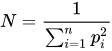
That is where the idea of the effective (rather than the actual) number of parties comes into place. The concept is satisfyingly described on Wikipedia, from where I also copied the formula, although I use a slightly different one. 

Formula to calculate the effective number of players
It looks more complicated than it actually is. You basically take 1 (if you work with percentages) and divide it by the sum of the squares of the shares. In the case of our two exemplary parliaments, the number of effective parties in the first one would be 2.8 and in the second one 2.3, so the difference is actually reversed in comparison to the simple count. This difference is however much closer to reality than following the naive assumption and counting all the units the same way.

We can apply this concept to football easily, we simply have to adjust the formula a bit and of course use minutes or starts instead of seats or vote shares. Given that minutes played by all the players in a team are variable (due to injuries and sending-offs, a team's players not always play the sum of 11*90 minutes), we have to make the values comparable. We do this by not dividing 1 by sum of squares but using the square of the sum as the dividend. 

To make this a little clearer, we'll apply this to a very simple example, a team which in a single match makes three substitutions at half time and compare it to a team which plays with the same eleven players during the whole game. The first team would have 

(90+90+90+90+90+90+90+90+45+45+45+45+45+45)^2 

divided by 

(8100+8100+8100+8100+8100+8100+8100+8100+2025+2025+2025+2025+2025+2025)


effective players, i.e. 12.74. The team without substitutions accordingly would have 11 effective players.


By applying this formula to the sum of minutes played and starts throughout the season so far, we can calculate the effective number of players and starters for each team. 


Graph 4 (click to enlarge)
By comparing the actual and effective numbers of players used, we can see how many players teams give minutes and also how evenly they distribute minutes among them. A quick look at graph 4 shows that teams cluster to a certain point. St. Pölten stands out in absolute terms, a strategy not really backed up by results so far (they will start the remaining from the last position). Rapid have given a lot of young players a limited amount of minutes without conceding them starts, meanwhile the rest of teams has used between 24 and 28 players out of which 21 to 27 have been starters. 

The picture clearly changes when we look at the effective numbers of players used and started. St. Pölten still leads the trail in terms of the amount of players used, but Salzburg have more effective starters, indicating a high level of rotation in the league. This might be a decisive advantage over title rivals LASK, who used the same number of players and just one starter less in absolute terms, but whose substitution players received far less minutes among them.

In the middle, there are a lot of teams in a quite congested area of the graph. Although I put the team names with an angle, there was no way to prevent this overplotting, because teams are quite close to each other, hence there are no big differences to expect for the rest of the season. Interestingly, the closely packed teams are all from the lower play-offs, with Austria Vienna having a slightly deeper and more balanced squad than their direct rivals. This might favour them to finish first in the lower play-off, a position that would give them the chance to qualify for Europe in spite of a rather underwhelming campaign so far.

At the end of the scale, there are those three teams which also used their players 15 and 16 the least (Graph 3). Wolfsberg, Hartberg and Sturm will battle for European qualification, but based on their squad depth and quality will not be able to join the title race, even with the point difference halved.

Sonntag, 6. März 2016

Sporting punished for being too focused on wide areas and crossing

The battle over leadership in the Portuguese highest league saw a very interesting game in tactical terms with two quite different half-times. After a passive start by the hosts, which was in part caused by Benfica’s high and intensive pressing, they took over control after the break without exploiting their superiority for a long time. In the end, the visitors were able to defend their marginal advantage until the final whistle.

Line ups and initial approaches

With the notable exception of central defence, where Oliveira and Naldo missed the game due to injury or a lack of fitness, and the surprising start of Bruno César instead of Gelson Martins, ex-Benfica and now-Sporting coach Jorge Jesús fielded his most-used players in the starting line-up. The inclusion of César seems justified ex-post given the specific role he played in the offensive midfield trio, out of which he was the most active player. He frequently moved up the pitch vertically and diagonally, trying to create numerical majorities in central areas and creating space for Pereira, which the latter was however unable to exploit. César would even switch to the left side for some time in the first half, leaving the right side totally uncovered since none of his teammates balanced this move. The intention behind this was unclear, and the asymmetric experiment was ended quickly.

Rui Vitória for his part had to do without his number one goalkeeper, veteran Júlio César, who was replaced by his younger fellow countryman Ederson (who had a good and faultless match). Benfica also were not able to field their usual central defence, but young Lindelöf was comfortable in the position usually played by Luisão or Lisandro. The rest of the team was made up by the usual starting eleven.

Line-ups with some typical movement patterns and the tactical duel between Carvalho and Jonas highlighted

This team started the game in a very proactive fashion. They organized themselves in an old-fashioned 4-4-2 formation against the ball, but pressed the home team very intensely during the first twenty minutes. The whole team moved up the pitch when in possession and did not retreat after losing the ball, but started aggressive counterpressing efforts, were regularly able to win the ball back quickly and hence keep Sporting away from their goal. 

They initially planned to build up their play in successive manner from the back, but quickly realized that Sporting would not allow them to play a continuous build-up game. Especially their full backs got isolated rapidly due to Sporting’s aggressive pressing in wide areas, the high positioning of their own wide midfielders when in possession and the rare support provided by their central midfielders. Benfica tried to overcome this problem by switching to a 4-2-4 when in possession with a narrow positioning of the offensive four, but were unable to cope with the obstruction of their build-up play. Their reaction was to opt for a long ball strategy after the initial minutes, often looking for Mitroglou as their target man, who was to forward the high passes to Jonas and Gaitán. The latter provided width in the final third, meanwhile his counterpart Pizzi stayed a lot deeper and narrower. One key player was Jonas, who acted very actively in central as well as wide areas. Once while drifting left, he was able to cross the ball into the direction of Mitroglou, which ultimately ended in the game-winning goal.

Sporting started the game much more cautiously than their counterparts and focused especially on counting attacks in the starting phase of the game. They defended much deeper, never applying an offside trap (which was an often used tool by the guests). One of the most interesting aspects of their defensive approach was the strict man orientation of William Carvalho on Jonas during the first half. He followed him almost everywhere in central areas and left him only wide zones to operate freely. When in possession, Carvalho’s task was to fall back between the left centre back and the left back in order to build their game from behind.

The general difficulties with Sporting’s game during possession was however an inadequate positioning of the more defensive players, which left holes especially in the centre of the pitch and them unable to link with the offensive players. At times, Silva was the only reachable player in the centre of the pitch, since João Mário too often moved forward into the same line as Slimani and was thereafter no viable passing option any longer. The centre backs positioned themselves too narrow, which meant that the full backs could not move up adequately and had to stay too deep. At the same time, their focus on trying to move the ball to the wings as quickly as possible was ever present. The build-up play was therefore pretty quickly ended by Benfica’s aggressive high pressing, leaving often only long balls as viable options for Sporting’s full backs, which were often enough useless due to Benfica’s offside trap.

A game-changing goal and adaptions after the break

In the 20th minute, Jesús’ decision to use Carvalho in an unusual, highly restricted role was punished by Benfica, although admittedly chance played an important role in the development of the goal situation. A cross by Jonas was cleared by the Sporting defence, hence the situation was almost over. But Carvalho, not needed to cover Jonas since the latter had drifted wide, was too focused on securing the last line of Sporting’s defence instead of moving a bit more forward to attack the second ball. He was therefore unable to intercept the far shot by Samiris, which was deflected and landed in front of Mitroglou, who exploited Carvalho’s slip to the ground and had no difficulties in putting his side ahead.

This goal changed the character of the game completely. Benfica, which was before the goal the dominant team, decided to stay deeper and let Sporting have control of the game. As a result, at half time possession was largely equilibrated. This does however not mean that Benfica did reduce their activities on the pitch to defending their lead. Their more cautious approach included longer phases of possession in their own part of the pitch (something almost completely unseen before the goal) and the maintenance of the long ball approach, Mitroglou and Jonas were largely free from defensive duties except some minor runs with the intention of pushing the deeper Sporting players sidewards.

At the same time, Sporting seemed to have no actual plan how to use their possession and turn it into danger for the guests’ goal. They maintained their focus on attacks down the flanks, but were unable to create dynamics on the wings, in spite of usually outnumbering Benfica in wide areas (especially on the left side in the middle third). They were therefore unable to create a single goal scoring opportunity within the box before half time, their chances were due to set pieces and shots from outside the box. 

The second half started in the same way as the first one. Benfica started pressing high up the pitch, but Sporting coped much better due to some specific adjustments made during the break which made that Benfica’s aggressive play lasted only for a couple of minutes. First of all, Carvalho was rid of the defensive impositions and allowed to move high up the pitch in the offensive phase of Sporting’s game and even dribbling the ball into the box, allowing them to attack with one man more.

Similarly, the wide offensive midfielders now tended to move in much smarter ways than before half time. Jesús had moved César definitely to the left side (until his substitution after an hour) and João Mário the right one, meanwhile Ruiz was given much more freedom when having the ball in central positions, but also had to support Slimani in his pressing efforts. Instead of getting isolated in pairs with the full backs between the second and last third in wide areas, the wingers moved diagonally towards the centre of the pitch, providing passing options and being able to start pressing if the ball got lost. This happened quite frequently, since crossing it was still Sporting’s preferred way of getting it into the box. They were supported in gaining the ball back by Silva who pushed up and played almost as high as Ruiz and a higher defensive line of Sporting. Their movements allowed the full backs, especially Jefferson on the left side, to move higher up the pitch and participate much more actively in the attacking situations of their team.

As time went by, Sporting managed to push Benfica more and more into their own half. Even counter attacks became more and more seldom, since Pizza and Gaitán got reduced almost completely to defending, partially due to Sporting’s changed approach down the wings. At times, Renato was the only midfielder who supported Jonas and Mitroglou (later Jiménez) in their counter attacking efforts. This does however not mean that Benfica permanently got into serious trouble. They were quite comfortable defending Sporting’s crossing, especially Lindelöf, who in the course of the game turned into some kind of man marker for Slimani. Before the crosses, they were ok with letting Sporting play, defending their own area and only seldom leaving their strict formation (if ever, only Renato and Pizzi moved forward in pressing efforts).

There was only one time when Sporting acutally managed to create real danger, which resulted in a terrible miss from Ruiz in a situation which was played almost perfectly. Slimani had received a diagonal pass from wide into the area and played the ball immediately to Ruiz, who managed to put the ball over the empty goal. This situation clearly showed that short, diagonal passing would be a better option for Sporting to create danger, but still they opted for the cross afterwards far too often.

The final minutes of the game were characterized by efforts of both coaches to change the result of the game using substitutions. Jesús brought on the more offensive Schelotto instead of João Pereira and replaced Silva with Gelson. This meant that Sporting had almost the same formation as Benfica, a flat 4-4-2 with João Mário besides Carvalho in central midfield and Slimani and Gutiérrez as strikers. At the same time, Vitória opted for strengthening the centre of the pitch by sending on Fejsa and later Sálvio, which meant that Benfica played the last couple of minutes with three central midfielders, still defending the box with fervour and not disclosing the possibility of leaving the opponent strikers offside.

Conclusions

In the end, it was a tough result to take for Sporting. They had not allowed Benfica a whole lot of goal scoring opportunities and dominated the game during three fourths of it. They were however not creative and dynamic enough to create danger themselves with the exception of Ruiz’ chance in the second half. Minor tactical errors such as the decision to impose predominantly defensive chores on Carvalho and their insistence on crossing the ball instead of looking for other solutions were castigated by Benfica, for whom everything went according to plan.

Samstag, 21. November 2015

Clásico analysis: Rafa risked and lost

In the end, Rafa Benítez tried to get the best of both worlds. He opted for a line-up which included all his most powerful offensive players, the BBC as well as James. This decision was risky in two ways: first of all, he had to drop Casemiro, the player who had provided cover for the more creative midfielders Kroos and Modric and the more advanced ones in the previous games. This meant that although there were more attacking players in the team, they also had to fulfil more defensive duties, a task in which most of them did not shine in tonight's game. Secondly, the decision to field three players (James, Bale and Benzema) who were not fully fit during the last weeks (especially the frenchman, who had not played since the start of October) carries the risk of having too many players who are not yet at their peak performance level in physical terms, which might especially harm high pressing efforts. He took these risks because he obviously wanted to have enough attacking power on the pitch in order to exploit possible weaknesses and because he trusted in his players and their defensive contribution, which would have been necessary to maintain the compact block he wanted his team to defend Barcelona's offensive efforts. This failed utterly; his team neither managed to create a lot of danger for the opponent's goal except in some periodes in the second half when the game already was decided. On the other hand, the fact that four of his players played only marginal roles in the efforts to win the ball back when Barcelona had it meant that his defensive four and the two central midfielders were often uncovered and outnumbered by the sheer attacking power of Barcelona. Benítez, who tried two make the best out of the two options he had (giving up elements of his playing style in order to counter the Barcelona threat, as Mourinho did, or maintaining the general style, like Ancelotti) which I have described earlier today, gambled and lost. He got neither.

His counterpart Luis Enrique did not take as much risk as Benítez. He could have fielded Messi, who like some of Madrid's starters had not played in a while, but decided to bench him and bring him on in the second half. His role was taken by Sergi Roberto and not like more often in the previous weeks by Munir. The rest of the usual 4-3-3 formation contained no surprises. To be fair, Enrique was also in a more comfortable position than Benítez; his team was three points ahead, therefore a draw would have been a result they could have lived with, meanwhile Benítez was under pressure to win to minimize the difference in points between the two teams. 

Line ups
The idea of Benítez was in general to defend compactely and let blau-grana have possession. When Barcelona was consolidated in possession, the block should retreat and not exercise pressure on the ballplaying opponent until about 35 meters in front of their own goal. Only in certain situations, for instance after goal kicks which were taken short and after possession losses in high and wide areas did Madrid try to win the ball back farther away from their own goal and applied some measures of counterpressing. Since this was not well-structured, they managed only seldom to create superiority in numbers and Barça was usually able to exit these situations without getting into danger of losing the ball or exposing their own goal. The general approach of winning the ball back in deeper zones had the effect that Barcelona controlled possession as was to suspect before the game. The value (55.9%) is itself a bit misleading because it was altered a lot after the game was decided, when Barcelona decided to sit a bit deeper and let Madrid have more of the ball. During the first twenty minutes of the game, Barcelona had 70% of possession, which is a better indicator of the real strength of both teams in today's encounter. 
 
The difficulty was that only six to seven players actively participated in the defensive efforts. Bale was the first pressing player when Barcelona built up play from their back four during most of the first half. During the opening minutes of the game Cristiano joined Benzema as a second striker when Madrid tried to press high (seldom enough), but Benítez switched Bale from the left flank in this 4-4-2 formation against the ball into the second striker role, moving Cristiano back into midfield after about 15 minutes. With either partner, Benzema was barely involved in pressing. If this was due to his lack of fitness or a tactical instruction of his coach is hard to judge, but his general low inclusion into his team's actions indicates the first option. He only played 18 passes during the game, the lowest number of any player on the field who played the full 90 minutes and six less than his own goalkeeper. When Barcelona got over this first pressing line, which was usually the case, Madrid retreated into deep positions as already outlined above. However, since Bale and Benzema were already ahead of the ball and Cristiano was usually not participating in defensive actions at all, Madrid had only seven players left to stop Barcelona's attacks. Of what should have been a narrow and compact 4-4-2 formation, only an asymmetric 4-3 cripple was left (see next picture). The result was that they were easily outnumbered, especially in central areas. The situation was too much for the two central midfielders, that is why a safety-first line up (including Casemiro) would probably have been the better choice for this game. The team tried to balance these weaknesses by single players (especially central midfielders and centre backs) leaving the formation occasionally in order to obstruct passing or ball reception, but this was seldom effective and most of the time only left even more holes in their formation which Barcelona were able to exploit, especially in the cases of the first and third goal.

Defensive shape of Real Madrid. Cristiano is not in position, leaving a lot of space exposed in his back. He obviously is waiting for his teammates to win the ball back and send him a long pass but does not participate in defensive actions. Kroos and Marcelo have to cover additional space, the whole team tends to get stretched and outbumbered. Bale had moved to a deeper position in pressing after halftime.
When in possession, Madrid usually looked for the first pass to be played long, especially after experiencing Barcelona's sophisticated pressing from early on in the game. They seldom managed to play the ball with shorter passes into the opponent's half. If so, they preferred to play in central areas until entering the attacking third, in which they usually played the sideway pass. 40% of their attacks came from their right side, due to the fact that on this side, James usually stayed on his position and received support by the vertical Danilo, meanwhile Marcelo on the other side was most of the time on his own because of Cristiano's regular runs into central positions. These runs were certainly part of their strategy. When they managed to build up their play from behind, Benzema tended to drop deeper and leave space behind him, which Cristiano was to exploit. This strategy was however not successful since Barcelona simply overloaded central areas (see the clear difference between both teams) personally and obstructed precise passes into these zones. They left Madrid effectively only three options: dribblings, long balls and crossings from wide areas. Madrid crossed excessively (27 times, of which five intents found a teammate) and played more long balls than usually this season (16% in comparison to 10% on average in the previous season), but found no effective way of getting behind the Barcelona defence until the game was decided. The main reason for this was (besides too large distances between the players, which were effectively covered by Barcelona, and the use of unefficient strategies such as crossing and long balls) was that their movement patterns were too static and too much focused on central areas. Once in the first half, Modric moved rightwards and allowed James to move centrally which resulted in the biggest chance of Madrid in the first half. But in general these complex moves were rare.
 
Barcelona on their behalf clearly had the plan to actively intercept Madrid's build up play from early on. They pressed centre backs and central midfielders aggressively by attacking them directly and trying to close passing lanes. The intent was to let them no other option than the long ball forwards. The most common pattern was for the central midfielders to move forwards and support the lone striker Suárez in his pressing attempts. The wingers dropped deeper and controlled the space between the ball and the opponent full backs (and any other player which would have dropped or moved sidewards). Neymar was especially active in defensive actions in the first half, played only 16 passes during the first 45 minutes but it was due to him that Madrid were not able to use their right side effectively. The holding midfielder Busquets provided cover in case the first pressing attempt failed, meanwhile the back four stayed on the same height and tried to minimize the space between the lines. When Madrid managed to get through the first line of pressing, Barcelona tried to form a central compact formation with all of the players in their own half. The result of their efforts was considerable. They forced Madrid's back four into a lot of unprecise passing. Every one of the five defensive players which played today (including Carvajal who came on for Marcelo) had a lower pass completion rate than in the first eleven games of the season. The worst case was Varane, who dropped from his usual rate of almost 92% to an embarassing 72%.
 
Typical Barcelona pressing moment. The wide player farer away from the ball (in this case Neymar) moves inwards, but stays approximately as high as his counterpart, meanwhile the central midfielders and the central striker exercise pressure on the ball playing opponent and the players around him.
Unlike in previous years, Barcelona use their aggressive pressing not only to win the ball back and circulate it afterwards, but actively exploit transition moments through vertical play. They are however still one of the best teams in the world when in possession and showed that they can use these qualities even if their best player is sitting on the bench. When in possession, their full backs moved up high the pitch in order to provide width. The wide midfielders Neymar and Roberto were allowed to run or dribble diagonally in order to exploit central spaces which Madrid's bad positioning had exposed. The two central midfielders displayed different behaviour in these phases. Meanwhile Rakitic usually ran forward to additionally enter the space which Cristiano should help defend, Iniesta was way more active and made also a lot of horizontal runs to the left flank, from which he would often play long diagonal balls into the free space. This helps explain why Barcelona, which before displayed a very even distribution of attacks from the centre and down both sides, attempted 42% of their attacks in this game from their left side. In central midfield positions, they tried to move forward using quick passing combinations before incorporating the three players highest up the pitch, often giving their counterparts lectures in one-touch football. This explains their high amount of passes played (50 more than in the previous games on average). Suárez on his part also covered a lot of space and frequently moved from central positions into the halfspaces, especially when the wide players were moving into central positions in order to stretch the opposition back four. Before the first goal he was therefore able to exploit one of the runs Ramos had made, leaving his position in the back four, and could finish almost without being disturbed. 

To be honest, the game was more or less over at half time. Benítez tried to save the game by letting his team attack higher up the pitch while at the same time moving Bale back in pressing in order to let Barcelona have less space in build up play, but he was unable to effectively correct the errors of the first half. Instead of moving Cristiano to the centre a let some other player fill the position he was barely found in, Benítez let Marcelo (later Danilo) and Kroos struggle with way too much space to cover for another half. Barcelona quickly castigated Madrid with another two goals which were a result of Madrid's back four getting out of position too easily, meanwhile Madrid managed to create some chances afterwards without scoring one. Bravo occupied the role which was reserved for Navas earlier in the season and made some magnificent saves, but overall Madrid was never close to Barça in terms of shot quality, despite a final STR of 0.5. Only in the 68th minute did Real Madrid counter for the first time successfully in the game. 
 
Some interesting details in the second half were Messi's deep role, who played almost the same position as Rakitic who he had replaced, before temporarily moving into a higher position, which turned the formation of Enrique's team basically into a flat 4-4-2, the one Benítez would have wanted his team to play in when out of possession. On the other side of the pitch, Carvajal showed that when fully fit he should be the first choice for right back in Madrid, given that he offered much more diagonality to the team than Danilo who most of the time ran down and back the side line. As a result, Carvajal was involved in two shots (one taken by himself plus one key pass) in little more than half an hour of play, meanwhile Danilo was involved in not a single one during the whole game.

In the end, Benítez gambled and lost. Enrique's side pointed out their weaknesses and shoed no mercy in exploiting them. The title race is perhaps already over after less than one third of the season. The question remains whether Benítez is given the chance to correct these errors or if he is himself blamed as part of the problem and sacked correspondingly, as some Spanish media already suppose. This would make his first Clásico as a coach also his last. His only positive thought tonight might be that José Mourinho suffered a similar debacle in his first game in charge in Madrid against Barcelona but had the opportunity to build the team of records which won the liga the following season, the last league title for Madrid so far.

Clásico preview: two ever-closer teams?

Ahead of tonight's clash between probably the two best teams in the world, there are still some issues which are open and up for an educated guess. Besides some personal issues (for instance concerning the state of James or Messi), one of the most interesting questions will be how both teams will start the game in tactical and stylistic terms. Times in which the games between these two clubs were not only battles of club culture and transfer philosophies but also of playing styles are over. Instead, both clubs have come closer in certain aspects, for instance in terms of transfer spending. A closer analysis of some KPI of the last eight liga clásicos shows that this process also takes place in terms of playing style. Meanwhile the games between the clubs when coaches of the likes of Mourinho and Guardiola were in office were marked by a strict antagonism of reactive and rigid, transition-based football applied by Real Madrid and the uncompromising possession football of Guardiola's Barça, changes of managers have led to the evolution of both clubs' playing style away from the ideal points in the continuum between possession- and transition-based football.

In the first four of these eight games, in which Real Madrid were still under the command of José Mourinho, Barcelona clearly dominated possession. They never had less than 60% of it, the values in games against Real Madrid were furthermore only slightly lower than in all the other games. Mourinho did in other words normally not try to obstruct Barcelona's usual style of play but was happy to let them take the initiative, let his own team sit deep and wait for the opponent's errors in order to exploit them rapidly. His team played on average only slightly more than 300 passes in these four games, way below the average value in these two seasons (538 in 2011/12 and 478 in 2012/13, respectively). He adapted his own tactics while not trying to force Barcelona into adapting theirs. At least in these four games, his approach was quite successful; Madrid won two of them and lost only one. Aggregate TSR and STR values of these four games (0.57 and 0.59 in favour of Real Madrid) also show that success in these games was not down to luck, but in general the tactics employed by Mourinho's Madrid were effective in containing Barcelona's attacking power. 

The pattern since then has changed. The number of passes played by Real Madrid in direct duels has risen constantly, meanwhile that of Barcelona declined steadily. In other words, Madrid under Mourinho's successor Ancelotti adapted a more active style in trying to have more of the ball and at the same time destroying Barcelona's game earlier and higher up the pitch. Although they still played less passes against their rivals than against other teams on average with a slightly lower success rate, they also allowed them to play less passes. Graph 1 shows this development, using as indicators the percentage of all passes in the respective game played by Real Madrid and the team's pass success.

Graph 1
Data shows the important differences between Mourinho's and Ancelotti's sides. Meanwhile in the four earlier games Real Madrid played 30 or less percent of all passes in all but one game, they played less than 40% only in one of the latter games. Similarly, passing success was constantly below 80% under Mourinho's mandate but only once while Ancelotti was in office. Again, Madrid also had a higher pass rate under Ancelotti in all other games than under Mourinho, but differences were only minor in those, meanwhile it dropped sharply when facing Barça under Mourinho's reign and much less under Ancelotti's. Interestingly, Ancelotti's approach in games against the rival did not turn out to be as successful as Mourinho's pragmatism. His team won only one game and lost the remaining three, a much worse balance than his predecessor's. Like results, also performance indicators had declined in comparison to the four games under Mourinho (TSR to 0.47 and STR to 0.53).

Pass success rate is among other factors (such as passing skill of the passer, the positioning of his team mates, height and intensity of the opponent's pressing, etc.) strongly dependent on the length of passes played. Simply put, the longer a pass is, the lower the probability it is completed, since the difficulty of placing it correctly increases with distance. The data of graph 1 lets one suppose therefore that Real Madrid also played more short passes in direct confrontations with los culés in the latter games than when Mourinho was in charge. 

Graph 2 confirms this hypothesis. In each of the games under Mourinho, at least one in five passes was longer than 25 yards. In one game, the rate was even below 70%, although in general Mourinho did not take a long ball approach. In all games, the rate of passes shorter than 25 yards was slightly below 90%. This underlines again the altered approach Mourinho usually opted for against Barcelona. In line with the reliance on deep defending and quick counter attacks, his team did not waste a lot of time trying to keep the ball in possession, but rather tried to pass it quickly into more dangerous zones after winning it back in their own half. Under Ancelotti, the rate was below 80% under once and almost reached 90% in his second year. In other words, the style of his team against Barcelona in terms of passing was almost undistinguishable from the one in games against other opposition.

Graph 2
On the other hand, the curve of Barcelona is much smoother than the one of their counterparts. Under Guardiola's successor Tito Vilanova (games 3 and 4), they played even more short passes, while the rate during the respective first game under the following coaches Martino and Enrique. 

Since it is relatively hard to determine whether these statistics are based solely on altered approaches in single games (although it is likely) or down to a more profound evolution of a team's playing style and in order to put them in context, graph 3 shows a comparison of some of the style-relevant indicators over the full seasons. The values were calculated by dividing Real Madrid's average by Barcelona's. Hence, if the value is below one, Barcelona displayed a higher value in comparison to their counterparts and vice versa. 

Graph 3
Indeed, values in 19 out of 20 observations (four KPI in five seasons) are below one, hence Barcelona performed "better" in these terms than Real Madrid. There is however an interesting development going on. Additionally, differences are not equal among KPI. The lines of pass success and the percentage of short passes are relatively constant and not much below one, i.e. the differences between Barcelona and Real Madrid were only minor and did not change a lot during the last four seasons and the current one. The differences in possession and passes per game are much more pronounced and volatile. If we look at the evolution of the differences over time, we observe a trend towards 1 for all indicators. In other words, the teams are becoming more similar in terms of playing style in the long term. The value of each indicator is higher in this season than they were in 2011/12, the last one in which Real Madrid managed to win the league. There was a sharp decline for all indicators in the following season, the last one under Mourinho, and a smaller one between the first and second season under Ancelotti. The long-term development is in any case upward. Under their new manager Benítez, Real Madrid manage for the first time a better pass success rate than their Catalan counterparts, although values for this season are still based on a quite low number of games. The game tonight will show to which dimension the positive trend in this season is down to substantial development.

What can we then take out of these findings and expect for tonight's game? Despite the ongoing trend of harmonization of the teams' playing style, it is still the case that Barcelona tend more towards a possession-based football style. They had more of the ball in all of the last clásicos and will probably do so today as well. In line with last year's games, their amount of possession will however be most likely between 50 and 55% and not above 60. Both teams will play roughly the same percentage of their passes short and have more or the less the same pass success rate. The biggest unknown besides the fitness level of some key players is Rafa Benítez, who will coach in a clásico for the first time and won only four out of his eleven games as a coach against Barcelona. His regularly underlined focus on his teams' balance indicates that he might be more of a pragmatist in the sense of Mourinho than an Ancelotti-like idealist when it comes to facing Barça. In this case, it would not be too surprising if he decided to play Casemiro, benched two of his galactic offensive players (probably Isco and James) and ordered his team to stay deep and narrow, exploiting Cristiano's and Bale's pace in offensive transitions. His team's numbers are however the most similar to Barcelona of any Madrid team of the last years, which is why he might also opt for a more proactive approach tonight. What is clear is that the game will no more represent a clash of football style civilization as it did some seasons ago.

All data extracted from whoscored.com.


Click on graphs to enlarge.

Samstag, 14. September 2013

Taktikanalyse Austria Lustenau gegen SV Mattersburg

Das Spitzenspiel der letzten Runde im ersten Viertel der zweithöchsten Spielklasse versprach eigentlich eine recht interessante Partie zu werden, wurde jedoch vor allem in der zweiten Hälfte zu einem Schaulaufen. Dennoch können einige durchaus interessante taktische Aspekte aufgezeigt werden.

1. Die Formationen


Beide Teams traten in der formal gleichen Formation auf; vor der Viererabwehrkette spielten zwei Sechser, hinter einer Solospitze wurde eine offensive Dreierkette aufgeboten. Bei den Hausherren wurde dieses System jedoch viel flexibler und moderner interpretiert als bei den Gästen, die sehr starr die Positionen hielten und das Spiel generell wie eine typische Auswärtsmannschaft anlegten. Dabei ging es vor allem darum, nicht wieder drei Gegentore zu bekommen wie in den bisherigen drei Auswärtspartien, weshalb mit Seidl auch ein gelernter Sechser vor den beiden Abräumern Prietl und Lovin spielte. Dieser Plan ging jedoch innerhalb von nur 25 Minuten in der ersten Halbzeit ordentlich in die Hose.


Graphik 1: Die Startformation von Austria Lustenau


Während Austria-Coach Kolvidsson ein im Vergleich zum Vorjahr runderneuertes Team auf den Platz schickte mit nicht weniger als acht Neuzugängen in der Startelf, war beim SV Mattersburg kein Feldspieler in der Anfangsformation, der im Abstiegsjahr keine Bundesligaerfahrung gesammelt hätte. Torhüter Thomas Dau hat als einziger noch kein Bundesligaspiel bestritten, ihm kann man die klare Pleite jedoch am wenigsten ankreiden. An mangelnder Erfahrung kann es also nicht gelegen haben, dass die Mattersburger das Spiel deutlich verloren und über das ganze Spiel zu keiner zwingenden Torchance im Strafraum kamen.


Graphik 2: Die Startformation des SV Mattersburg

2. Die Spielanlagen 


Die ersten zehn Minuten ließen bereits die Spielanlagen der beiden Mannschaften erkennen; die Hausherren setzten auf Ballbesitz im Mitteldrittel und ließen sich von Mattersburg erst einmal nicht aus der Reserve locken. Die Gäste positionierten sich enorm tief und standen grundsätzlich nur (mit zeitweiliger Ausnahme von Stoßstürmer Klemen) in der eigenen Hälfte. Bei Balleroberung in der eigenen Hälfte wurde der Ball meist weit und hoch nach vorne gespielt und sollte vor allem von Klemen weiterverarbeitet werden, der dafür auch oft auf die Seiten auswich. Aufgrund zu langsamen Vorrückens seiner Mitspieler fand er jedoch wenig Anspielstationen und wenn, dann fehlte er oft bei deren Hereingaben in der Mitte. Dazu kamen in vielen vielversprechenden Kontermöglichkeiten mangelnde Präzision im Zuspiel und technische Mängel bei der Ballannahme. Deshalb kam Mattersburg in Halbzeit 1 nur zu einem einzigen ernstzunehmenden Torschuss, und das erst beim Stand von 3:0.

Lustenau hielt den Ball hingegen in den eigenen Reihen und positionierte sich hoch, ohne anfänglich viel Risiko zu nehmen. Interessant war vor allem das kollektive Positionsspiel, das die Gastgeber praktizierten. So kippte situationsbedingt einer der beiden Sechser Fall oder Bolter nach hinten ab, um mit den beiden Innenverteidigern eine Dreierkette zu bilden. Diese Vorgehensweise ist zwar nicht neu und wird beispielsweise vom FC Barcelona schon seit Jahren praktiziert, interessant ist allerdings, das dafür keiner der beiden Sechser fix vorgesehen ist, sondern situationsbedingt einer der beiden in diese Rolle schlüpft. Die Dreierkette bot den Außenverteidigern die Möglichkeit, weit nach vorne zu schieben und mit den offensiven Außenstürmern offensive Pärchen zu bilden, womit die beiden Mattersburger Außenverteidiger in Hälfte 1 häufig überfordert waren. Vor allem der ballferne Außenverteidiger positionierte sich weit vorne, was seinem Kollegen auch die Möglichkeit gab, einzurücken, woraus beispielsweise das 3:0 durch Schreter resultierte.


Sehr flexibel wurden die Positionen wiederum von den zentralen Offensivspielern Thiago und Salomon interpretiert; sie orientierten sich sowohl auf die Flügel, um dort Anspielmöglichkeiten zu bieten und Überzahlsituationen zu schaffen, rochierten aber auch miteinander sehr viel, wodurch sie von der Mattersburger Defensive, trotz deren prinzipieller Überzahl im Zentrum, nie in den Griff bekommen wurden.


Auf den seltenen Ballbesitz der Burgenländer reagierten die Gastgeber mit aggressivem Pressing, vor allem ab dem Mitteldrittel und dahinter. Obwohl das Pressing nur selten kollektiv und systematisch angewandt wurde, bekam es den Mattersburgern gar nicht. Einerseits verloren sie viele Bälle schnell wieder, ohne Gefahr kreieren zu können, andererseits waren sie nach den Ballverlusten defensiv völlig unorganisiert, was die Tore zum 2:0 und 3:0 verursachte. Auch die Standardsituation, die dem 1:0 voranging, resultierte aus einer schnellen Balleroberung Lustenaus in der gegnerischen Hälfte und einem deshalb notwendig gewordenen taktischen Foul. Nach dem 4:0, das zwar insgesamt auch durch viel Pech für Mattersburg verursacht wurde, allerdings wiederum wie das 1:0 enorme Schwächen bei der Zuordnung bei Defensivstandards offenbarte, war das Spiel de facto entschieden.

3. Zweite Halbzeit 


Mattersburg-Coach Tatar reagierte naturgemäß auf die inferiore Leistung seiner Mannschaft in der ersten Hälfte. Statt Lovin brachte er als zweiten Stürmer Pink, Seidl rückte nach hinten und bildete mit Prietl das defensive Mittelfeldduo. Außerdem tauschten Höller und Farkas auf der rechten Seite die Positionen; Höller agierte ab dem als Außenverteidiger, der defensiv in der ersten Halbzeit oft überforderte Farkas agierte offensiver und brachte auch etwas Schwung in das Offensivspiel der Burgenländer, die fortan mit vielen hohen Flanken aus dem Halbfeld auf das Sturmduo agierten, was allerdings auch kaum für Gefahr für das Tor von Knett sorgte. Nicht nur formal, sondern auch strategisch änderte sich das Mattersburger Spiel in der zweiten Hälfte. Man positionierte sich höher und agierte bei gegnerischem Ballverlust konzentrierter und aggressiver, womit man Lustenauer Torchancen weitgehend verhindern konnte, auch weil diese ihr Offensivbemühungen beinahe komplett eingestellt hatten. Das Konterverhalten der Gäste wiederum blieb weiterhin mangelhaft, weiterhin wurden hauptsächlich hohe, weite Bälle nach vorne gespielt, die von den Lustenauern dankbar erobert wurden.


Graphik 3: Die Mattersburger Formation nach den Umstellungen in Halbzeit 2


Mitte der zweiten Halbzeit wurde das Mattersburger System komplett umgestellt; der junge Karanezi ersetzte den kaum präsenten Röcher und reihte sich als Linksverteidiger ein, womit auch auf der anderen Seite die Außenverteidigerposition neu besetzt wurde. Rath spielte dafür fortan offensiver. Außerdem wurde Malic nach vorne gezogen, womit defensiv nur eine Dreierkette übrigblieb. Malic ordnete sich hinter den Stürmern ein und sollte nun selbst die hohen Bälle weiterverarbeiten und auch im Strafraum selbst für Gefahr bei hohen Flanken sorgen, schaffte es allerdings auch nicht, Torhüter Knett ernsthaft in Bedrängnis zu bringen.


Die Gastgeber wiederum konnten sich in der zweiten Halbzeit schonen. Sie beschränkten sich meist darauf, den Ball möglichst lange in den eigenen Reihen zu halten und wenig Risiko zu gehen. Die durchaus vorhandenen Räume, vor allem nach den erwähnten Umstellungen bei Mattersburg, wurden kaum genützt, man verzichtete fast komplett auf Konter. Stattdessen wurden Kräfte eingespart und darauf geachtet, das Zentrum wie auch schon in Hälfte 1 besetzt zu halten und den Mattersburgern nur die Option der niemals gefährlich werdenden hohen Bälle von der Seite offen zu lassen.


Bild 1: Die Lustenauer Austria im Ballbesitz. Gut zu erkennen: Die Dreierkette mit Fall und den Innenverteidigern sowie das nicht vorhandene Pressing der Mattersburger. Auch wenn diese Situation aus der Schlussphase stammt, kann sie doch als symptomatisch für das gesamte Spiel angesehen werden.


4. Fazit 


Durch die vielen Tore, die den Lustenauern innerhalb von nur 25 Minuten in der ersten Hälfte gelangen, konnte aus dem Spiel keine wirklich spannende Partie werden, obwohl sie durchaus interessante Details zu bieten hatte. Hierzu zählen auf Lustenauer Seite die situationsbedingte Dreierkette in Ballbesitz, die hohe Positionierung der Außenverteidiger, die einrückenden Außenstürmer und die flexibel spielenden zentralen Offensivspieler Thiago und Salomon. Mattersburg wiederum setzte auf hohe Bälle und tiefe Positionierung, packte erst Mitte der zweiten Hälfte so etwas wie die Brechstange aus und löste die Viererkette auf. Allerdings konnte dies die Versäumnisse der ersten Halbzeit, vor allem schwaches Konterverhalten und defensive Unordnung, nicht mehr ausgleichen, womit der Lustenauer Sieg auch in dieser Höhe gerecht erscheint. Nach Anlaufschwierigkeiten in der Saison zeigen die Vorarlberger damit, dass sie durchaus bundesligareifen Fußball zeigen können, während für die Burgenländer die Mission Wiederaufstieg in dieser Verfassung keine realistische Möglichkeit zu sein scheint.